
In the core application scenarios of the water industry, including water treatment plant monitoring and water supply pumping stations, precise control of flow and liquid level and achieving data traceability are crucial for ensuring water supply safety and optimizing operational efficiency. Duweyintelli draws on the International Electrotechnical Commission (IEC) 61508 standard, relevant ISO specifications, and the experience of over 1,000 global water projects to provide customized professional equipment and solutions for global partners. [Authenticity Note: IEC 61508 is an international standard for functional safety widely used in water automation systems; Relevant ISO standards (e.g., ISO 9104) are general specifications for flow measurement, and the above description is accurate. Adaptability to core application scenarios: Precise matching of equipment selection and operating conditions
Usage scenario adaptation: Precise matching of equipment selection and operating conditions
Application scenarios in the water industry involve complex water quality (including suspended solids and corrosive substances) and variable operating conditions (high/low pressure, large/medium/small pipe diameters). Equipment selection must adhere to the core principle of “strong adaptability, high precision, easy operation and maintenance”. The following is a scientific selection plan for specific scenarios:
Water plant monitoring scenario: accurate measurement throughout the entire process
Key aspects: Raw water intake metering, process flow monitoring (coagulation/precipitation/filtration, etc.), clear water tank outlet metering, and water distribution network flow monitoring
Liquid Flow Meter Selection:
Raw water/sewage applications: Electromagnetic flowmeters are the preferred choice. They are suitable for conductive media with conductivity ≥5 μS/cm, have strong corrosion resistance, and an accuracy range of ±0.5%. This technology complies with ISO 9104:1991 (Performance Standard for Electromagnetic Flowmeters) and has been applied in a municipal water treatment plant in Melbourne, Australia, achieving accurate low-flow metering.
Fresh water metering: Turbine flow meters (accuracy ±0.5%) or ultrasonic flow meters (accuracy ±0.5%) are ideal for fresh water applications.
Large-diameter pipelines (DN > 500): Clamp-on ultrasonic flow meters can be installed without cutting the pipeline, and their cost is only 60% of that of electromagnetic flow meters of the same diameter.
Level gauge selection:
Fresh water tank / sedimentation tank: Ultrasonic level gauge (non-contact design to prevent contamination, measurement error ≤ ±3mm).
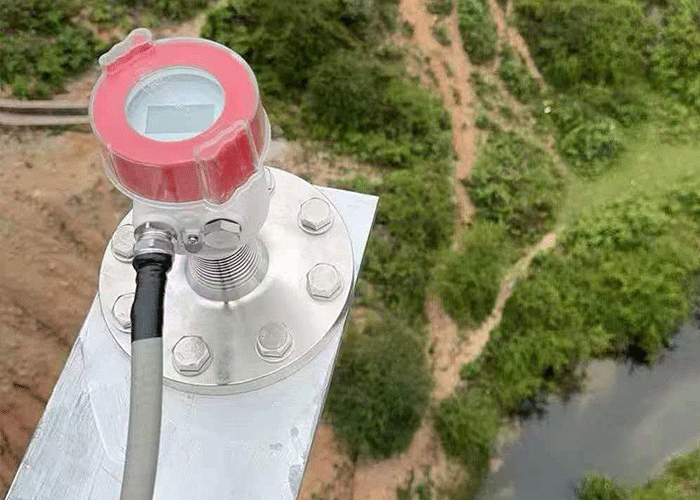
Sludge tank: Radar level gauge (corrosion-resistant, moisture-proof, protection rating ≥ IP67, compliant with ATEX 2014/34/EU requirements for hazardous areas).
Application Scenarios of Feed Pumping Stations: Stable Control and Efficient Operation and Maintenance
Key aspects: monitoring of pump station inflow, adjustment of booster pump outflow, coordinated control of sump water level, and adjustment of pipeline pressure matching flow
Flowmeter selection:
Normal operating conditions: In-line electromagnetic flowmeter (suitable for high-pressure environments up to 42 MPa).
Retrofit project: Insertion ultrasonic flowmeter (no need to cut the pipe, suitable for pipes DN300 and above, with significant cost advantages).
High-pressure outlet: Turbine flowmeter (high-pressure resistant, ensuring stable measurement of pressurized water flow).
Liquid Flow Meter: The “Measurement Hub” of the Water System
As the core data source for water operations, flow meters play a crucial role in four aspects: metering, process optimization, safety, and compliance. Water departments across Europe and North America have incorporated flow meter data into their core evaluation indicators:
Precise Measurement: Reducing Resource Waste: The electromagnetic flowmeter has an accuracy of up to ±0.5%, which can serve as the basis for the settlement of raw water procurement and clean water supply, reducing water quality measurement errors to the lowest level in the industry. After a medium-sized water plant in Germany adopted this equipment, it reduced water waste by approximately 30,000 cubic meters annually.
Process Optimization: Reducing Operating Costs: Real-time flow data is integrated with the chemical dosing system to ensure precise matching of coagulant dosage with water volume. A wastewater treatment plant in Canada reduced chemical usage by 15% and saved over $30,000 annually through this integration.
Fault Warning: Minimizing the Impact of Water Outages: A sudden drop in flow indicates a possible leak in the pipeline, while an unexpected increase in flow suggests a valve malfunction. A water supply pumping station in the United Kingdom reduced pipeline repair time from 4 hours to 1 hour and the number of affected households by 8,000 through a flow anomaly alarm system.
Compliance Assurance: The flowmeter provides traceable data that meets the requirements of the EU Water Framework Directive (WFD) and the US Safe Drinking Water Act (SDWA), thereby streamlining compliance checks for environmental and water utilities departments.
Level Gauge: The “Protective Barrier” for Water Safety
The level gauge plays a core role through “overflow prevention, idling protection, and seamless system integration”, making it a necessary safeguard for equipment safety and process stability. According to the Statistical Data of the International Water Association (IWA), the safety accident rate of pumping stations equipped with intelligent level gauges has been reduced by 60%:
Safety Protection: Avoiding Equipment Damage: Real-time monitoring of the water level in the clean water tank, triggering automatic shutdown at high water levels (to prevent overflow) and issuing early warnings at low water levels (to avoid idling). A pumping station in the Netherlands avoided idling damage to 3 booster pumps through timely water level gauge alarms, saving $18,000 in maintenance costs.
Automatic Integration: Improving Operational Efficiency: Seamlessly integrated with the pumping station control system, it enables fully automatic operation (“start at low level, stop at high level”). A water treatment plant in Auckland, New Zealand, has achieved unattended operation using this system, reducing labor costs by 70%.
Supply-demand balance ensures stable water supply: Accurate water level data of the clean water tank helps predict peak water consumption. A municipal water plant in California, US, increased the reliability of peak water supply from 95% to 99.8% through water level-based scheduling.
Process coordination stabilizes effluent water quality: A stable sedimentation tank water level prevents water flow turbulence and ensures effective sedimentation. After implementing this control measure, a water treatment plant in France maintained the effluent turbidity below 0.5 NTU, exceeding the standards of the EU Drinking Water Quality Directive.
Data Records: The “Decision-Making Cornerstone” of Smart Water Management
According to the requirements of the European Union’s General Data Protection Regulation (GDPR) and the US Environmental Protection Agency (EPA), water-related data must be retained for at least 3 years. In addition to serving as compliance records, these data are also core assets for operational optimization. A smart water plant in Singapore achieved a 44% reduction in energy consumption through Data drive analysis:
Trend analysis facilitates capacity planning: Retaining flow data for more than three years enables accurate prediction of peak water usage patterns. A municipal water authority in the United Kingdom used this data to optimize its water treatment plant expansion plan, avoiding unnecessary investment exceeding $10 million.
Quick troubleshooting of fault tracking: By correlating abnormal traffic and water level data, the occurrence time of pipeline leaks and equipment failures can be accurately located. A pumping station in Belgium has reduced the fault detection time from 2 days to 4 hours by analyzing historical data.
Cost optimization facilitates low-carbon operations: By correlating traffic and energy consumption data, the operation plan of pumping stations can be optimized. A water supply system in Spain adopted this approach, reducing electricity costs by 22% and saving $55,000 annually.
Streamlining compliance processes and achieving regulatory reporting: Standardized data ledgers can be directly integrated with the US Environmental Protection Agency (EPA)’s online monitoring platform and the European Union’s Electronic Pollutant Release and Transfer Register (E-PRTR). A German wastewater treatment plant leveraged this integration to reduce monthly reporting time from 1 day to 2 hours.
Product and Service Advantages
Duweyintelli’s flow and level instruments have multiple international certifications such as ISO9001, CE, UL, and FM, are compatible with mainstream industrial communication protocols such as Modbus, and are suitable for European and American SCADA systems. The brand provides multi-language one-stop services throughout the entire process of selection, installation and commissioning, and data management, helping global water projects achieve accurate measurement, safe operation and maintenance, and digital intelligent decision-making.